Post Your Needs

Calacatta Gold Marble

White - Marble

Italy

About

Item Details

Material Type:
Marble
Origin:
Italy (Sovicille, Provincia di Siena, Toscana)
Primary Color(s):
White
Recommended Usage:
Kitchen and bathroom countertops, monuments, building stone, ornamental stone, stairs, interior, exterior wall and floor applications, mosaic, waterjet pattern, wall panels, table tops
Additional Names:
Calacatta Gold Vein Marble, Calacatta Golden Marble, Calacata Oro Marble, Calacatta Oro Marble, Calcutta Gold Marble, Marmo Calacatta Vena d`Oro, Calacata d'Oro Marmo, Calacata Gold Marble, Calacatta Doro Marble, Calacatta Siena Marble, Calacatta di Siena Marble, Calacatta Golden White Marble, Fish Maw Gold Marble, in China stone market:金丝卡拉卡塔白(Jīn sī kǎlā kǎ tǎ bái), 鱼肚金(Yúdù jīn), Calacatta Gold Marble
Finished Surface:
Polished,Bush Hammered,Tumbled,Brushed,Honed,Split,Machine Cut,Natural Surface,Sandblasted,Acid Washing,Combed,Leathered,Water Jet,Filled,Chiseled,Pickling

Testing

Water Absorption:
0.22 - 0.28 mass%
Density:
2725 kg/m3
Flexural Strength:
12.3 MPa
Compressive Strength:
122.0 - 126.0 MPa

Description

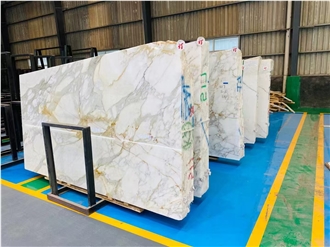
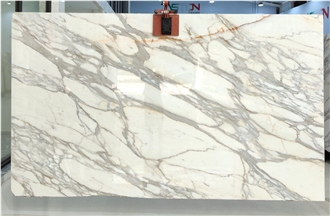
Calacatta Gold Marble is a high-quality and luxurious type of marble known for its distinctive white background and stunning golden veins. It is highly sought after for its elegant appearance and is often associated with luxury and sophistication.

Calacatta Gold Marble is quarried primarily in Italy, specifically from the region of Carrara. It is characterized by its white or creamy white base color, which provides a clean and bright aesthetic. The veining in Calacatta Gold Marble is typically bold and dramatic, with golden, amber, or yellow veins that traverse the surface in a random or sweeping pattern. These veins can vary in thickness, intensity, and distribution, making each slab of Calacatta Gold Marble unique.

This marble is commonly used in high-end residential and commercial applications, such as countertops, backsplashes, floorings, and wall claddings. It is particularly favored in spaces where a touch of luxury and elegance is desired.

Due to its popularity and distinctive appearance, Calacatta Gold Marble is often considered a premium and more expensive option compared to other marble types. When using Calacatta Gold Marble, it is recommended to handle and care for it properly to maintain its beauty and longevity.

As always, it's advisable to view samples in person or consult with a stone supplier or professional to better understand the specific characteristics, variations, and availability of Calacatta Gold Marble for your particular project.

Petrographic definition: breccia marble
Massa Unit Volume: 2725 kg/m3
Water Absorption: 0.22%
Breaking Load Compression Simple: 126 MPa
Compression breaking load after freezing: 122 MPa
Tangent elastic modulus: 45,700 MPa
Tensile indirectly by bending 12.3 MPa
Its coefficient of Abrasion (referred to Granite St. Fedelino): 0.58
Impact resistance: minimum fall height: 36 cm
Linear thermal expansion coefficient of 3.9 x 10⁻⁵ 0C-1
Knoop microhardness: 1354 MPa
Index of non-uniformity of hardness: 1.25
Source: Università di Pisa - Politecnico di Torino

FAQ

Are there color variations of Italy's Calacatta Gold Marble?

Yes, there can be some variations in color in Calacatta Gold Marble. The base color is usually white or off-white with prominent veining in shades of gold or light beige. However, the intensity and distribution of the gold veining can vary from slab to slab, resulting in variations in appearance. Some slabs may have more pronounced golden veins while others may have a softer or more subtle veining pattern. It is always recommended to view and select the specific slab when working with natural stone like Calacatta Gold Marble.
Read question details

Will water stain on white marble go away?

Water stains on white marble may disappear on their own over time as the water evaporates and the stone dries. However, if the water stain persists or leaves a noticeable mark, it may need to be treated or repaired. Depending on the severity of the stain, various methods can be used to remove it, such as using a poultice or a marble-specific cleaner. If you are unsure how to treat the stain, it is recommended to consult a professional or a marble specialist for guidance.
Read question details

What is the coefficient of friction of Chiseled Italy's Calacatta Gold Marble tiles?

The coefficient of friction of Chiseled Italys Calacatta Gold Marble tiles can vary depending on the specific finish and polishing process applied to the tiles. Generally, marble tiles have a low coefficient of friction, which means they are relatively slippery. However, the chiseled finish on Calacatta Gold Marble tiles typically provides some texture and roughness, which can increase the coefficient of friction to improve traction and reduce slipperiness. It is recommended to consult the manufacturer or supplier for the specific coefficient of friction values for Chiseled Italys Calacatta Gold Marble tiles.
Read question details

How thick is Italy's Calacatta Gold Marble slabs?

The thickness of Calacatta Gold Marble slabs can vary depending on the specific supplier or manufacturer. However, a commonly available thickness for Calacatta Gold Marble slabs is typically around 2 centimeters (0.79 inches) or 3 centimeters (1.18 inches).
Read question details

Can Italy's Calacatta Gold Marble be used in heavy use areas?

Calacatta Gold Marble is a stunningly beautiful marble variety known for its luxurious appearance and rich veining. While it is a durable material, it may not be the best choice for heavy use areas. Marble, in general, is a softer and more porous stone compared to other natural stones like granite or quartzite. This means it is more susceptible to scratches, stains, and etching caused by acidic substances. Heavy use areas, such as high traffic floors or heavily used kitchen countertops, can experience more wear and tear, making marble less suitable for these environments. However, if you are willing to accept the natural patina and potential flaws that may develop over time with heavy use, Calacatta Gold Marble can still be used in these areas. Regular maintenance, including sealing the marble regularly and using protective coasters and cutting boards, can help minimize the damage and extend its lifespan. Ultimately, the decision to use Calacatta Gold Marble in heavy use areas should be based on your personal preference for the aesthetic appeal and the willingness to accept the potential wear and tear that may occur. If durability is a primary concern, it may be advisable to explore more resilient options such as granite or quartzite for heavy use areas.
Read question details

What is the average compressive strength of Italy's Calacatta Gold Marble?

The average compressive strength of Calacatta Gold Marble, which is sourced from Italy, is typically around 20-30 MPa (megapascals). It is important to note that the compressive strength of natural stones can vary depending on factors such as the specific quarry, slab thickness, and quality of the material. Therefore, it is always recommended to consult with a supplier or manufacturer for precise information regarding the compressive strength of a particular batch or source of Calacatta Gold Marble.
Read question details

What grade is Italy's Calacatta Gold Marble?

Italys Calacatta Gold Marble is typically considered to be of the highest grade, often referred to as premium or top grade. It is highly sought after for its luxurious and unique appearance, and is known for its white base with distinct veining in gold and gray tones.
Read question details

What is the physical properties of Calacatta Gold Marble?

Calacatta Gold Marble is a high-quality marble known for its elegant and luxurious appearance. The main physical properties of Calacatta Gold Marble include: 1. Color: Calacatta Gold Marble is characterized by its white background with distinctive golden veins running across the surface. The golden veins can vary in intensity and pattern, ranging from thick bold veins to more delicate and refined ones. 2. Texture: This marble has a smooth and polished surface, giving it a refined and timeless look. It has a fine-grained crystalline structure. 3. Hardness: Calacatta Gold Marble is a relatively hard stone, ranking around 3 on the Mohs scale of mineral hardness. It is not as hard as granite but is resistant to scratching and is suitable for use in various applications. 4. Durability: It is a durable and long-lasting stone, making it suitable for both interior and exterior applications. However, like all natural stones, it can be sensitive to acidic substances like vinegar and citrus juices, which can etch the surface. 5. Water Absorption: Calacatta Gold Marble has a low to moderate water absorption rate, meaning it is less prone to water damage and staining compared to more absorbent stones. 6. Availability: Calacatta Gold Marble is a premium and sought-after stone, known for its rarity and limited availability. It is quarried mainly in Carrara, Italy, and is considered one of the most prestigious white marbles in the world. Overall, Calacatta Gold Marble is prized for its distinctive aesthetics, durability, and timeless elegance, making it a popular choice for countertops, flooring, wall cladding, and various other applications in both residential and commercial settings.
Read question details

What is the chemical composition of Calacatta Gold Marble?

The chemical composition of Calacatta Gold Marble can vary slightly depending on the specific quarry it is sourced from. However, it generally consists of the following minerals: 1. Calcite (CaCO3) - This is the primary mineral present in Calacatta Gold Marble and gives it its characteristic white color. 2. Dolomite (CaMg(CO3)2) - Sometimes, dolomite is present in small amounts, giving the marble a slightly yellowish or brownish tint. 3. Quartz (SiO2) - Quartz can be found in trace amounts in Calacatta Gold Marble, contributing to its durability and resistance to abrasion. 4. Other minor minerals - Calacatta Gold Marble may contain traces of other minerals, such as mica, pyrite, and various silicates. These minerals can add unique patterns and colors to the marble. Its important to note that the chemical composition of natural stone can vary, and specific analysis of a sample from a particular quarry would provide more precise information on its composition.
Read question details

Can Calacatta Gold Marble surface be leathered finish?

No, Calacatta Gold Marble cannot be leathered. Leathering is a finish typically applied to granites, and it involves a process of brushing the stone surface with diamond-tipped brushes to create a textured, leather-like appearance. Calacatta Gold Marble is a type of marble, and it has a different composition and texture compared to granite. It can, however, be polished, honed, or have a matte finish applied to it.
Read question details

and****

Bonjorno, Please tell me what a price is this marble stone peace?

Reply

Les****

what R rating and PEI rating are these tiles?

Reply

Customer reviews

Project Show

Calacatta Gold Marble Villa Kitchen Countertop Project

Calacatta Gold Marble Villa Kitchen Countertop Project

Calacatta Gold Marble Villa Kitchen Countertop Project

Products & Prices

View More

Hot White Marble

New Marble

Post Your Request

The request includes:
  1. surface finished, size
  2. quantity required